

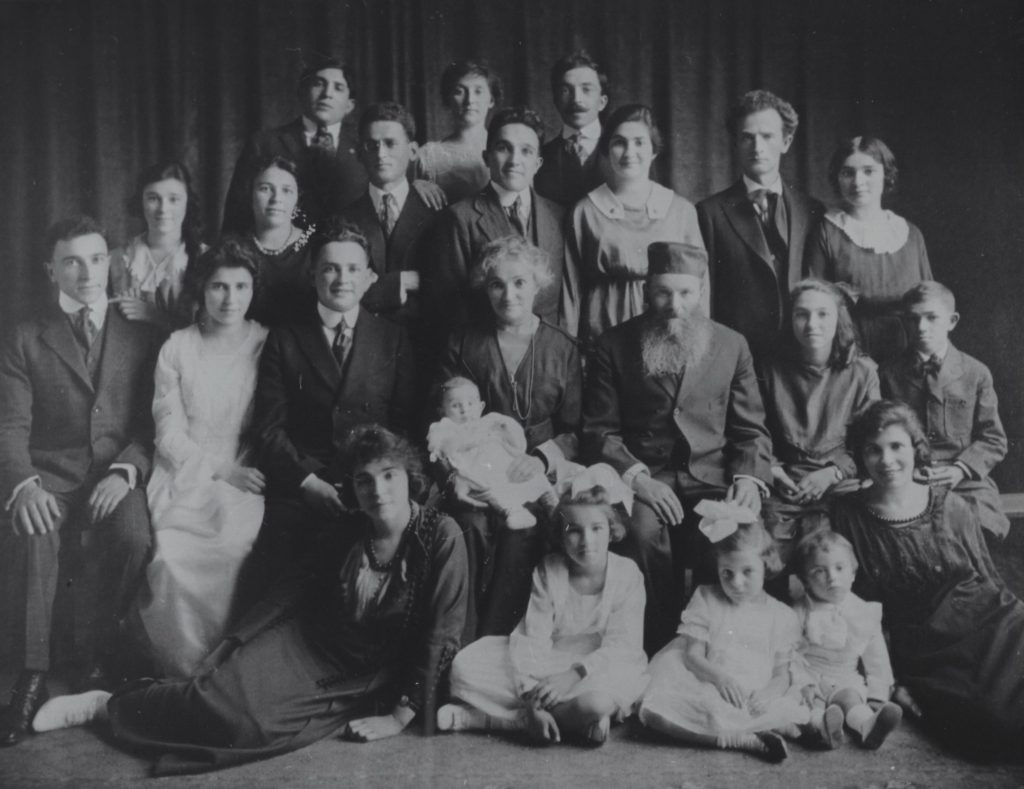
Shumiatcher Family
Judah Shumiatcher had been a farm manager in Russia. He and his son Morris came to Canada (c.1910) and homesteaded in the Rumsey area. The eldest son, Abraham, had remained in Gomel to prepare for the immigration of his mother and nine brothers and sisters.
Before long, Judah and Morris moved to Calgary and sent for the rest of the family. Confusion arose when a government official found the surname too difficult and changed it to “Smith.”
Judah brought the first Torah to Calgary. Many years later it was restored by Rabbi Heyman and celebrated in a ceremony at the Glenbow Institute. It now resides at Beth Jacob Synagogue.
Abe became a teacher at Talmud Torah, and later was involved with I.L. Peretz Institute. He married his childhood sweetheart Luba Lubinsky. He was called to the Bar in 1930 and eventually became a King’s Counsel.
Morris Shumiatcher hitch-hiked to California to pursue his acting ambitions. He landed a part as an extra in a silent film with Mary Pickford but soon returned and founded Calgary Hat Works (which later became Smithbilt Hats and is still in operation). His white felt cowboy hats were introduced by the Herron family at the 1946 Stampede parade and became a symbol of Calgary.
Six of Judah’s children decided to make Calgary their permanent home: they were Abraham, Morris, Eva (Busheikin), Annie (Paperny), Bessie (Shapiro) and Billy Smith.
The other children of Judah and Chasa Shumiatcher were Harry Smith, who ran Harry’s News in Calgary before moving with his family to Vancouver; Esther (Ethyl), who married Peretz Hirschbein, a famous Yiddish poet, while he was teaching at the Calgary I.L. Peretz School, and who became a well-known author in her own right; and three remaining sisters, Fanny Ziskin, Bella Abbey and Sarah Wiener, who all pursued professional musical careers in New York.
Judah Shumiatcher died in Calgary in 1923; his wife Chasa died much later.
Their descendants are a vibrant part of our Jewish life today.